AI expands learning – but who sets the framework?
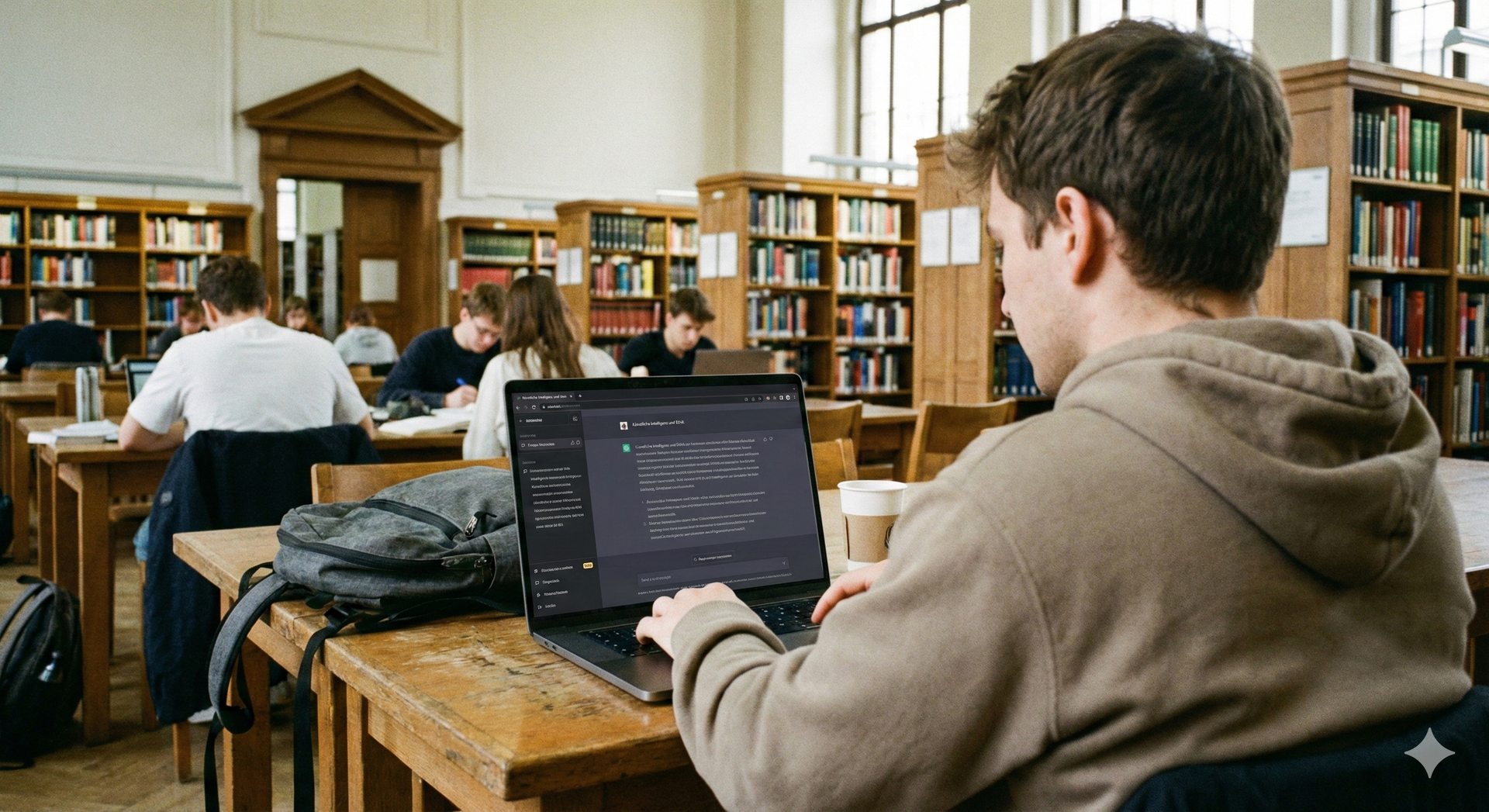
My observation is that AI greatly expands learning – it enables deeper understanding and new connections. A bit like the Wikipedia moment, when you suddenly had access to collectively formulated knowledge articles. Do you remember? That feeling when a topic interests you and you suddenly jump from article to article, getting deeper and deeper, more and more connected?
AI has expanded this even further. Now I can not only read, but also ask questions. Not just consume, but delve deeper through dialogue. I can explore connections that I would not have seen before. The expansion is enormous.
At the same time, I realise that this expansion makes structured learning even more important. The contextualisation of content and topics is crucial for acquiring sound knowledge.
Expansion as a challenge
When everything is possible, the question ‘What is relevant to me?’ becomes a core competence. The sheer availability of information and explanations does not automatically mean that we learn better. Initially, it only means that we can do more – if we know how.
This is where a concept comes into play that has been on my mind for some time: biographicality. The Göttingen-based education researcher Peter Alheit coined this term. He uses it to describe our ability to connect our own experiences to new challenges and thereby continuously develop individual solutions.
Biographicity means that your life story is your learning potential. What you have experienced, how you have learned, what successes and failures you have had – all of this structures how you absorb new knowledge today. Your biography is not just the past. It is both a filter and a resource.
And this is precisely where the opportunity – and the challenge – of AI in learning lies.
Biography as a learning framework
When I learn with AI, I bring my entire learning biography with me. My previous experiences, my knowledge gaps, my way of thinking. The AI knows nothing about this at first. It responds to my questions, but it doesn't know my context.
This means that I have to provide the framework. I have to know what I am looking for. I have to ask my questions in such a way that they help me progress – not just lead me into the next flood of information.
Alheit distinguishes between three ways in which biography and learning interact:
- Biography as background: My existing experiential knowledge influences all learning processes, often unconsciously.
- Biography as a field of learning: I actively contribute my experiences and use them as material.
- Biography as an object: I reflect on my life story and thereby open up new areas of development.
For learning with AI, this means that the more aware I am of my own learning biography, the more purposefully I can use AI as a tool. Without this awareness, there is a risk of arbitrariness – lots of information, little understanding.
Learning as identity work
This is where a second thought comes into play that preoccupies me. Harvard researcher Herminia Ibarra has shown with her concept of ‘working identity’ that professional change is always also a transformation of identity.
A career change – or even just learning new skills for your current job – is not simply ‘skill acquisition’. It is the exploration of possible selves. Ibarra talks about ‘possible selves’ that we try out before we know who we want to become.
That may sound like a big question for ‘How do I use AI for learning?’. But I think that's exactly the point:
If AI enables us to learn everything, we have to decide who we want to become.
This is not a technical question. It is a biographical question. A question of identity.
Ibarra recommends not planning, but experimenting. Trying small experiments, exploring new networks, retelling your own story. This fits surprisingly well with the question of how we should use AI in learning:
- Experiment instead of perfecting: Try out how you learn with AI. There is no ‘right’ way.
- Context before information: First ask yourself why you want to learn something before you ask what.
- Narratives instead of facts: Link new knowledge to your story. What does that mean for you?
School as a testing ground
I am currently exploring this topic intensively because it concerns me in connection with my work at school. How should AI be used? How can its use be sustainable?
Research on lifelong learning shows that people develop their learning behaviour over the course of their lives. At school, we often learn in the short term and with a focus on exams. At work, learning is self-directed and must be reconciled with competing demands.
The challenge is: how do we prepare young people for learning that will accompany them throughout their lives – with tools that we ourselves are only just beginning to understand?
I believe the key lies not in technology, but in reflection. The central question is not ‘How do I use ChatGPT?’ but ‘How do I learn – and how do I want to learn?’
This requires structures. Not structures that constrain, but structures that provide orientation. Frameworks that help us understand our own learning biography. Spaces where experimentation is possible.
Invitation to exchange
How do you use AI for your learning? Do you feel that it helps – or sometimes confuses you? How do you find your framework in the wealth of possibilities?
I would love to hear your thoughts – write a comment or send me a DM if you have the time and inclination. Then we can do a little interview. Your perspectives would help me to better understand the topic.
Because in the end, that's exactly the point: learning is not an individual sport. It requires dialogue, feedback and other perspectives. AI can do many things – but it cannot replace this human exchange. It can only enhance it.
Sources:
- Alheit, P.: Konzept der "Biographizität" – Biografie als Lernpotenzial im Lebenslauf
- Ibarra, H. (2003): Working Identity: Unconventional Strategies for Reinventing Your Career. Harvard Business School Press. herminiaibarra.com
And receive regular updates from my digital garden.