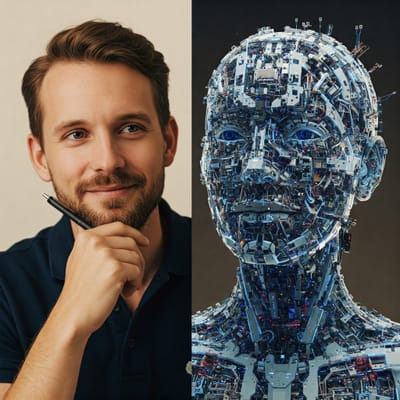
The Narcissism Trap of AI

Large Language Models seem like a miracle.
We type a question. Seconds later, we receive an answer—structured, linguistically polished, and often astonishingly nuanced. It feels as though we’re facing a foreign intelligence—an entity that thinks, synthesizes, explains, and articulates.
But perhaps this very impression is the most intriguing illusion of our time.
For an LLM is not an alien form of thought. It was trained on human texts: on books, websites, forums, scientific articles, code, comments, manuals, marketing copy, debates, and the linguistic sediment of the internet.
When we speak with an LLM, therefore, we are not speaking with something outside our world of knowledge. We are speaking with a machine that computes patterns from our world of knowledge.
That’s brilliant. And it calls for reflection.
The Global Library on Server Farms
The brilliance of LLMs is obvious: they give us new access to the global library.
However, this library is not global in the ideal sense. It consists of what is available in digital form, what dominates linguistically, and what is economically well-developed. English is overrepresented. Western discourses are overrepresented. The most powerful models originate from the U.S., with corresponding product logics and cultural biases.
This imbalance is well documented. Training data does not reflect humanity as a whole, but rather those parts of it that write, publish, and are visible online (Science for the People: Stochastic Parrots).
Nevertheless, the access it provides is historically remarkable. Never before have so many people been able to work with condensed global knowledge so quickly. An LLM explains concepts, compares arguments, sorts ideas, and simulates perspectives. It never tires and always has an analogy up its sleeve.
However, it does not open a window to the truth. It generates linguistic responses based on patterns found in human texts.
Less of a source of knowledge, more of a mirror of knowledge.
Narcissus before the Interface
This is where the actual train of thought begins.
Ovid tells the story in the Metamorphoses (Book III, 339–510). Narcissus leans over a spring, sees a face in the water, and falls in love. He mistakes the image for another person. He speaks to it, stretches out his arms, waits for a response. Only later does he realize:
“iste ego sum! sensi”—“It is I myself! I have recognized it.”
Ovid, Metamorphoses III, 463
But this realization does not save him. He cannot break free. He wastes away before the image of himself.
An astonishingly precise metaphor for our interaction with LLMs.
We, too, stand before a mirror. Only this one is linguistic, interactive, and very persuasive. It responds to us. It expresses itself more eloquently than we might be able to ourselves. It organizes our unfinished thoughts. It gives us the feeling that “something” is thinking.
But this “something” is trained on human knowledge. It mirrors our ways of thinking, our concepts, our biases, our blind spots, our cultural routines.
If we forget this, we are not falling in love with the machine. We are falling in love with a technically enhanced version of our own thinking.
That is the narcissistic moment.
We consider the answer to be radically new because it seems foreign to us. Yet it is often a recombination of what humans have already thought and written. That doesn’t make it worthless—recombination is at the heart of creative work. But there’s a difference between using an LLM as a thinking partner and granting it the status of an independent source of insight.
New thoughts or rearranged patterns?
Of course, LLMs generate new formulations. They combine terms in surprising ways, draw analogies, and shift concepts. In this sense, new forms do indeed emerge.
Yet this novelty is not creative autonomy in the human sense. It arises from statistical pattern processing, not from experience, responsibility, or an embodied relationship with the world. An LLM has no biography. It knows no existential concern. It does not know what it means to be wrong. To it, error is merely a text pattern.
This does not mean that language models are “merely parrots.” This oversimplification often falls short. But the critique of so-called Stochastic Parrots remains important: models produce plausible language without this automatically implying understanding, truth, or responsibility (Bender et al., FAccT 2021).
This is precisely why we need a new form of literacy. Not prompting. Not tool proficiency. But an understanding of what comes back when I input my knowledge, my question, and my context.
From Mirror Image to Knowledge Partner
Narcissus does not fail because of the mirror. He fails because he recognizes it as a mirror too late.
So, is there a need for something to complement this? I think so: LLM literacy. Not prompting, not tool proficiency. It unfolds in three stages:
First stage: the reflection of thought. I ask a question and receive an answer that I like. It sounds smart because it sounds like me—only more eloquent. I recognize myself in it and take that for insight. The mirror validates me.
Second stage: the reflection of knowledge. I understand that the answer reflects not only me, but an entire textual universe: its concepts, conventions, prevailing opinions, and omissions. The model shows me what is common and plausible in its data—not what is true. The mirror becomes legible.
Third stage: the knowledge partner. I work consciously with this reflection. I ask not only for answers, but also for omissions: Which perspective is missing? What assumption is already embedded in my question? Which position would contradict this? Where is this answer plausible simply because it’s common?
This shifts the role of humans. We aren’t becoming obsolete. Our judgment becomes more important. Precisely because LLMs are linguistically convincing, we must scrutinize, contextualize, and take responsibility.
LLM literacy is therefore a form of epistemic self-knowledge.
I must understand what I know. I must recognize what I do not know. And I must see when the machine is primarily reflecting back to me my own thinking—only more fluently, more quickly, and with better punctuation.
What Narcissus Never Asked
In Ovid’s tale, Narcissus asks exactly one question too few. He asks, “Who are you?” He never asks, “Where does this image come from?”
Anyone who wants to read the reflection of an LLM must first know their own position. These five questions are therefore not directed at the model, but at ourselves.
- **Whose language am I speaking right now?**What concepts, schools of thought, and academic traditions am I bringing into the question—and what worldview do they convey?Narcissus speaks to the image without realizing that it is his own voice.
- **Who taught me that this answer sounds “good”?**What socialization, education, or professional culture shapes my sense of what constitutes a good argument?He finds the image beautiful because it meets his own standards.
- **Which voices are missing from my question?**Which regions, languages, social milieus, or spheres of experience aren’t even represented in my line of questioning?Echo calls out in the background—but she can only repeat what he himself has said.
- **What is validating me right now—and why does that feel good?**Am I seeking insight or approval? And how would I tell the difference?“quod petis, est nusquam” — “What you seek is nowhere to be found.” (Ovid III, 433)
- What would have to be true for this answer to be false? What counterevidence would I accept? And did I even ask for it in the first place?For Narcissus, the realization comes too late because he never uses it to test his assumptions.
These questions don’t provide answers. They make the mirror visible. That’s already a lot.
The mirror is useful as long as we recognize it
LLMs are among the most powerful knowledge machines of our time. They give us access to an unprecedented condensation of human language. They accelerate thought processes and make connections visible.
But they remain mirrors—not passive ones, but active, computational, language-shaping mirrors. They do not show us the world, but rather the world as reflected through the traces of human texts.
The question, therefore, is not whether we use LLMs. The question is whether we know what it is we’re using.
Those who see a counterpart in the mirror lose themselves. Those who recognize the mirror as a mirror gain a partner in knowledge.
Perhaps this is the central skill of the coming years: not extracting better answers from machines, but developing a better relationship with these answers.
Don’t fall in love with the mirror. Learn to read it.
An LLM mirrors your knowledge. So it’s worth organizing that knowledge. My free Roadmap to the Second Brain shows you how—12 chapters, 9 principles, a 5-week plan.
Sources
- Ovid: Metamorphoses, Book III, 339–510 (Narcissus and Echo)
- Bender, Gebru, McMillan-Major, Shmitchell (2021): On the Dangers of Stochastic Parrots, FAccT — dl.acm.org
- Emily Bender on the interpretation of “Stochastic Parrots” — IEEE Spectrum
- Representation problem of the training data — Science for the People
And receive regular updates from my digital garden.